
concept · thermal-printing
Direct Thermal vs. Thermal Transfer Printing
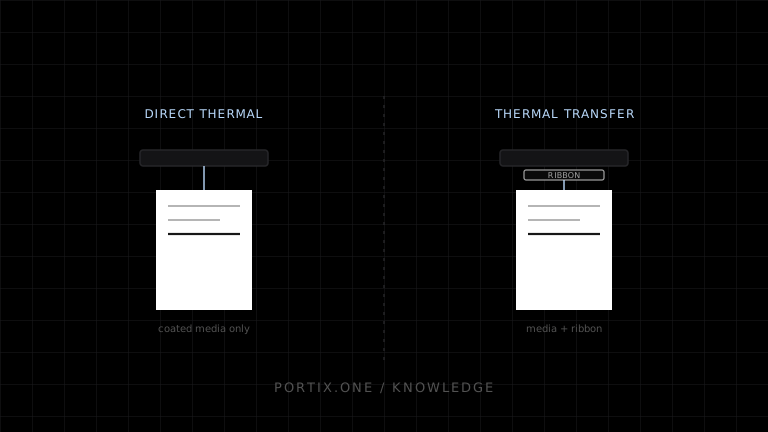
Quick answer
Choose direct thermal for short- or medium-life receipts, tickets, and labels when simple operation and no ribbon are more important than resistance to heat, light, or abrasion. Choose thermal transfer when labels need longer life, synthetic materials, or stronger resistance to handling and environmental exposure. Neither method is universally better: validate the complete combination of printer, media, ribbon when applicable, barcode design, and real operating conditions.
Direct thermal and thermal transfer printers both use a heated printhead, but they create the mark differently. The right choice depends primarily on how long the output must remain readable, what it will be exposed to, and which media the application requires.
At-a-glance comparison
| Criterion | Direct thermal | Thermal transfer |
|---|---|---|
| Image formation | Heat activates coated media | Heat transfers material from ribbon |
| Ribbon required | No | Yes |
| Media choices | Heat-sensitive paper or synthetic stock | Paper and a broad range of synthetic stock |
| Typical durability | Lower and environment-dependent | Higher with correctly matched supplies |
| Heat/light sensitivity | Usually higher | Depends on ribbon and substrate; generally lower |
| Consumable handling | Media only | Media plus ribbon |
| Setup complexity | Lower | Ribbon/media matching and loading required |
| Common uses | Receipts, shipping labels, tickets | Assets, products, outdoor or chemical-exposure labels |
| Waste stream | Used media and liner where applicable | Media/liner plus spent ribbon |
How direct thermal works
Direct thermal media contains a chemical coating that darkens where the printhead applies heat. Darkness and speed settings control how much thermal energy reaches the surface.
Strengths
- No ribbon to purchase, load, align, or dispose of.
- Simple media changes and compact mechanisms.
- Good for variable, on-demand receipts and labels.
- Fewer supply combinations to manage.
Tradeoffs
- Output can react to heat, ultraviolet light, abrasion, plasticizers, oils, or chemicals.
- Long storage or harsh handling requires careful media qualification.
- The entire media stock is specialized and heat sensitive.
How thermal transfer works
A ribbon passes between the thermal printhead and the label. Heated elements release its coating onto the substrate. Common ribbon families include wax, wax-resin, and resin, but formulations and compatibility vary by supplier.
Strengths
- Greater potential durability with a matched ribbon and substrate.
- Broader selection of paper and synthetic materials.
- Appropriate for long-lived identification and demanding environments.
- Consistent mark density can support high-quality barcodes.
Tradeoffs
- Ribbon adds cost, inventory, changeovers, and waste.
- Incorrect ribbon/media combinations can smear, scratch, or bond poorly.
- The spent ribbon can retain a legible negative image of printed data, which may require secure disposal for sensitive labels.
Choose by required life and exposure
| Requirement | Usually start with |
|---|---|
| Point-of-sale receipt | Direct thermal |
| Short-lived shipping label | Direct thermal, after environment testing |
| Indoor inventory label with moderate life | Either, based on exposure and cost |
| Asset identification over years | Thermal transfer |
| Outdoor, high-heat, chemical, or abrasion exposure | Qualified thermal transfer system |
| Wristband or ticket | Application-specific direct thermal media is common |
| Product label with durable synthetic stock | Thermal transfer |
“Usually” is important. A premium direct thermal stock may outperform a poorly matched transfer system in a specific condition. Test the exact supplies.
Barcode quality considerations
Both methods can produce one-dimensional and two-dimensional symbols. Scan performance depends on more than the printing method:
- Printer resolution and the symbol’s module or X-dimension.
- Quiet zones and contrast.
- Heat/darkness and print speed.
- Ribbon-to-substrate compatibility.
- Surface texture, gloss, curvature, and application.
- Printhead cleanliness and missing dots.
- Verification against the applicable barcode specification.
GS1 guidance recommends technical barcode verification, not visual inspection alone. A barcode that looks sharp to a person can still fail the required grade or scanning environment.
Cost model
Compare total cost per usable label, not just printer or roll price:
media + ribbon + labor for changes + waste + maintenance
+ reprints + scan failures + premature replacement + downtime
Direct thermal removes ribbon costs but may require higher-grade media or replacement when life requirements increase. Thermal transfer adds a ribbon but can reduce failures for durable applications.
Sustainability and privacy
Evaluate liner, media, ribbon cores, spent ribbon, recyclability, and local disposal options. Claims such as “greener” require a defined boundary and supplier evidence.
Spent transfer ribbon can reproduce the sequence of printed areas. Organizations printing personal, medical, financial, or access-control data should include ribbon handling in their data-disposal policy.
A practical qualification test
- Define required readable life and barcode grade.
- Obtain the exact printer, media, ribbon, and adhesive candidates.
- Print at supported speed and darkness combinations.
- Verify symbols at initial production.
- Expose samples to expected heat, light, moisture, abrasion, chemicals, freezing, or curvature.
- Reverify after the required period or accelerated test designed by a qualified party.
- Document the approved supply combination and settings.
Frequently asked questions
Is thermal transfer always more durable?
It offers greater durability potential, but performance depends on the compatible ribbon, substrate, adhesive, application surface, and environment.
Is direct thermal cheaper?
It uses no ribbon and can simplify operations. Total cost depends on media grade, volume, failures, labor, and required label life.
Can one printer support both methods?
Many thermal transfer models can also run in direct thermal mode, but this is model-specific. Direct-thermal-only devices lack the ribbon mechanism.
Which method is best for shipping labels?
Direct thermal is common when transit and storage life are limited. Thermal transfer may be appropriate for long storage, heat, light, abrasion, or demanding logistics conditions.
References
- Direct Thermal vs. Thermal Transfer — Zebra Technologies, accessed Jul 18, 2026
- GS1 DataMatrix Guideline — GS1, accessed Jul 18, 2026
- GS1 Logistic Label Guideline — GS1, accessed Jul 18, 2026
Related content
concept
Label Printers Explained
Learn how label printers handle media, sensing, resolution, barcodes, ribbons, adhesives, and software for shipping, inventory, product, and asset labels.
concept
Receipt Printers Explained
Learn how receipt printers work, the differences between thermal and impact models, and how paper, cutters, connectivity, commands, and software affect POS printing.
concept
What Is a Thermal Printer?
Learn how thermal printers use heat to produce receipts, labels, and barcodes, including direct thermal and thermal transfer technologies.